The Fourth Layer: Why ACP and UCP Tell Only Half the Story of Agent Commerce
ACP versus UCP, the loud fight of agent commerce standards. Both protocols model the same case: external agent buys at the shop. A second configuration appears in no protocol, yet carries the bigger conversion lever. Why merchants need to set up on both axes in parallel.
In April 2026, Cloudflare launched the Agent Readiness Score. The first public industry standard that measures how well websites speak to AI agents. Cloudflare's own launch data: less than four percent of the 200,000 most-visited domains support Markdown content negotiation. Since then the discussion has been everywhere, from Shopware agencies to strategy consultants. But it is one-sided.
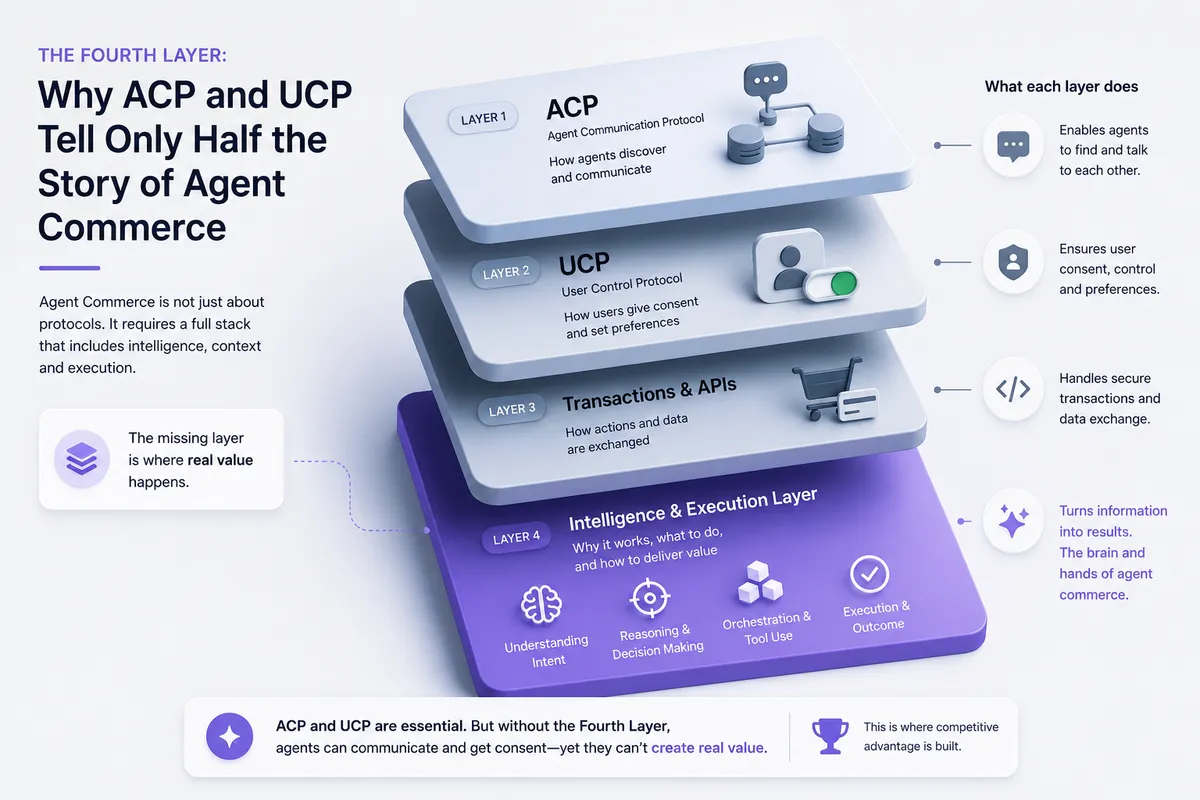
When the e-commerce world today talks about agent commerce standards, it almost always means the same fight: ACP versus UCP. Two protocols, two camps, two value propositions. OpenAI and Stripe on one side, Google and Shopify with their coalition on the other. Both compete to define the language in which AI agents will speak to online shops.
What is missing from the debate: both protocols share an architectural assumption. And that assumption only covers half of the reality.
The public fight, in short
In September 2025, OpenAI and Stripe introduced the Agentic Commerce Protocol (ACP). Function: standardized checkout out of ChatGPT. The user chats, ChatGPT finds the product, Stripe sends a Shared Payment Token, the merchant processes the order. Architecture: centralized. The merchant uploads catalog data to OpenAI, OpenAI hosts discovery. Cost: around 7.2 percent total, because OpenAI takes a 4 percent platform fee on top of Stripe's processing.
In January 2026, at the NRF conference in New York, Google delivered the answer. Universal Commerce Protocol (UCP), together with Shopify, Walmart, Target, Etsy, Wayfair, Visa, Mastercard, PayPal and others. Function: not only checkout, but the entire lifecycle from discovery through post-purchase. Architecture: decentralized. Each merchant hosts a JSON profile at /.well-known/ucp on their own domain, similar to robots.txt today. Cost: around 3.2 percent, no platform fee.
In March 2026, OpenAI walked back Instant Checkout. Almost no purchases in five months. In April 2026, Stripe joined the UCP Tech Council along with Microsoft and Salesforce. The governance battle is now effectively decided, even if ACP is not dead (sources: agenticcommerce.dev, Shopify Newsroom March 24 2026, CNBC March 20 2026, Cloudflare Blog April 17 2026).
What both protocols leave out
ACP and UCP differ on many points. On one central point they are identical: both model the case where an external agent comes to the shop. The user stays inside ChatGPT, Google AI Mode, Gemini or another platform interface. The agent is the messenger between that platform and the shop. Discovery, negotiation, checkout, post-purchase, all of it happens through the external agent layer.
This is an assumption, not a law of nature.
There is a second configuration that is just as real, and is missing from every one of these protocols: the user comes to the shop themselves and wants agent help on the page. They found the shop through search, social, recommendation, or direct visit. They are on the product page, inside the category filter, looking at the cart. They want to ask a question, set a filter, compare products, in natural language instead of ten taps through a mobile menu.
This second axis is not small. Mobile traffic accounts for between 60 and 70 percent of visits in most European shops, but converts at roughly one third of the desktop rate. The main reason: filter navigation and search are broken on small screens. This is exactly where the biggest unattended conversion lever sits today for most shops. And it is exactly where neither a UCP profile nor an ACP integration helps.
Why the second axis needs its own standards
At first glance the second axis looks like UCP turned inside out. It is not.
An external agent finishing a checkout via UCP has a clearly defined goal: find product, check price, get payment mandate, submit order. Actions are transactional and finite. Permissions are tight, state is short, the agent knows the user only through platform authentication.
An internal agent guiding a user on a product page works differently. It needs to understand what is happening on the current page. It needs to react to live changes when filters update or products lazy-load. It needs continuity across sessions when the user comes back. It needs to perform actions on the page itself, not against a backend API. Permissions, state, data flow, action model, everything fundamentally different.
Cloudflare's Agent Readiness Score measures axis one. Discoverability, bot access control, capabilities (MCP, OAuth, API catalogs), commerce endpoints. That is valuable, that is coming. But even a shop with a perfect score has not solved a single mobile conversion problem.
What merchants do now
Both axes are coming. The question is not whether, but in what order they become economically relevant for you.
For axis one (external agent): observe, run the Cloudflare scan at isitagentready.com, decide whether to set up a UCP profile under /.well-known/ucp. Effort: 8 to 16 hours of engineering. Main benefit: visibility in AI-driven discovery, relevant in 12 to 24 months.
For axis two (internal agent): measure honestly where mobile conversion fails today. Walk your own filter paths on a phone yourself. Identify bottlenecks. Evaluate tools that close this gap right now. Main benefit: immediate effect on mobile conversion rate, measurable in 0 to 6 months.
A shop that does both is ahead on both axes. A shop that does only one has understood half of the attention economy of the next years.
Most merchants I speak with focus on axis one today, because that is where they see the loud discussion. My impression from 18 months of building a solution for axis two (twwim.ai): the second axis carries the larger economic pressure but the smaller PR shine. That is exactly why it is underinvested.
If the model holds, the winner will not be the merchant who implements UCP perfectly. It will be the one who addresses both axes in parallel.